
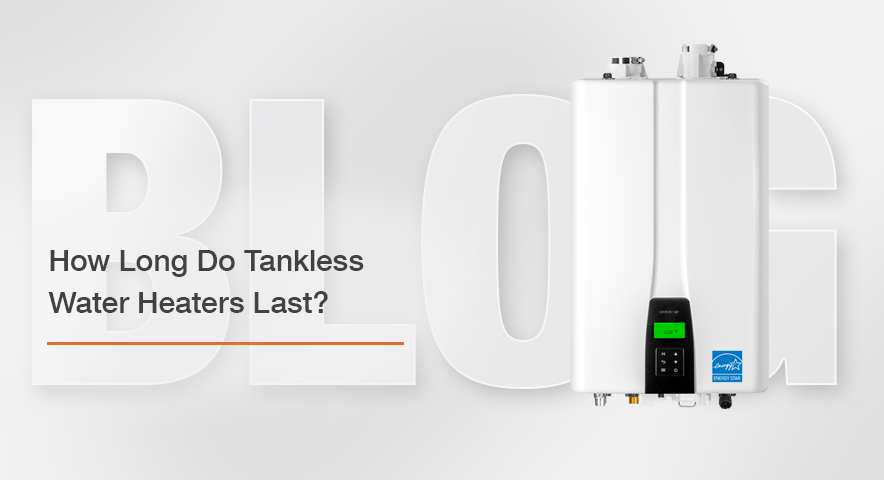
Tankless water heaters typically last 15 to 20 years or more with proper installation, good water quality, and routine maintenance. In many cases, they can provide a longer service life than traditional tank water heaters.
Rather than viewing “15 to 20 years” as an expiration date, think of it as a general lifespan range. Factors such as water quality, scale buildup, installation quality, maintenance, and household hot water demand can all influence how long a system performs effectively.
Understanding these variables can help you get more years from your new tankless system and make a wise repair-or-replace decision when an existing unit gets older.
What affects tankless water heater lifespan?
Water quality, scale buildup, installation, sizing, maintenance, and operating demand are the biggest factors affecting tankless water heater lifespan.
Water quality and scale buildup
Water quality has a direct effect on the longevity of the components that water touches inside a tankless water heater.
Hard water has higher concentrations of minerals like calcium and magnesium, which contribute to scale deposits inside piping and heat-transfer surfaces.
As scale builds up, it restricts water flow and interferes with heat transfer. That makes the water heater work harder and contributes to performance problems or component damage over time.
Improving your household water quality protects not only your plumbing, but also the service life of your water heater.
Installation quality
A tankless water heater is a complete mechanical system, not a plug-and-play appliance.
Gas supply, electrical connections, venting, water piping, condensate management (on condensing models), and other installation details must meet the requirements for the specific unit.
Professional installation by a qualified Navien installer ensures your tankless water heater has ideal operating conditions. Subpar installation can cause unnecessary stress on the system, inefficient heating, flow problems and other issues that affect long-term reliability.
Correct sizing
A tankless water heater should be sized for the maximum amount of hot water your household calls for at one time.
Sizing a tankless water heater depends on factors including:
- Required flow rate
- Incoming water temperature
- Desired outlet temperature
- Number of fixtures that may operate simultaneously
An appropriately sized tankless water heater can meet normal household demand without putting too much strain on the system, therefore protecting its service life.
Maintenance
Routine tankless water heater maintenance helps preserve flow, heat transfer, and proper operation while giving a qualified service professional an opportunity to identify developing problems.
To help your tankless system last longer, follow the maintenance schedule and procedures specified for your individual water heater. Hard-water conditions may require particular attention to combat mineral buildup and scaling.
Hot water demand
Consider two identical tankless water heaters. One serves a household of two people with modest hot water use. The other serves a large family with frequent showers, laundry, dishwashing, and hot water recirculation.
Both tankless systems can be the same age, but they won’t have experienced the same workload. This is another reason age alone can’t tell you how long a tankless water heater will last.
How long does a tankless water heater last with hard water?
A tankless water heater can still have a long service life in a home with hard water, but uncontrolled mineral scale can compromise performance and contribute to premature problems.
It’s not that hard water automatically reduces tankless water heater lifespan. Instead, what matters is how the hard water is managed. Luckily, dealing with hard water is straightforward:
- Know your water. Municipal water reports or water testing can help you determine whether hardness is an issue.
- Follow the maintenance requirements for your tankless water heater.
- Address scale at the water-treatment level.
Navien's WEC Series whole-home water treatment system is ideal for homes where hard water is a concern. WEC uses capacitive deionization and dual electromembrane technology to reduce calcium, magnesium, total dissolved solids (TDS), chlorine, and other substances without salt. Navien designed WEC to help prevent scale buildup throughout the home, including inside water-heater piping and components.
How can you help a tankless water heater last longer?
The best way to maximize tankless water heater lifespan is to mitigate the things that create unnecessary wear or interfere with heat transfer and water flow.
Focus on these basics:
- Have the unit properly sized for your household's hot water demand.
- Use a qualified professional for installation.
- Follow the manufacturer's maintenance requirements.
- Use an appropriate scale-management strategy if you have hard water.
- Keep air intake and exhaust pathways clear.
- Address recurring error codes (don’t just keep resetting the unit to clear them).
- Have a qualified service provider investigate leaks, unexplained temperature changes, and unusual noises.
- Keep service records so your provider can see the unit's repair and maintenance history over time.
How do you know when a tankless water heater is nearing the end of its life?
A tankless water heater is more likely to be approaching the end of its service life when age is accompanied by recurring problems, deteriorating major components or increasingly expensive repairs.
Warning signs include:
- Frequent or recurring error codes
- Increasing service calls
- Reduced hot water flow
- Difficulty maintaining the set water temperature
- Unexplained temperature fluctuations
- Internal leaks
- Significant heat exchanger deterioration
- Several major components requiring repair
- Increasing difficulty obtaining replacement parts
Look for a pattern, not just individual signs. Needing one repair on a 15-year-old tankless unit doesn’t necessarily mean it’s time to replace it. But several expensive failures in a short period might.
The distinction you want to make is component failure vs. system end of life:
- Component failure: One repairable part has reached the end of its life.
- System end of life: The overall condition or economics of the water heater no longer justify continued repair.
Knowing the difference can save you from replacing a viable system too early, or investing in repairs that aren’t worth it.
Should you repair or replace an older tankless water heater?
Repair makes more sense when the problem is isolated to one part, and the rest of the water heater is in good condition. Replacement makes more sense when major failures accumulate.
Parts availability can also come into play with older units. A serviceable water heater is difficult to keep in service if replacement components are no longer readily available.
Changing household needs can play a part as well. If your existing unit was undersized or if your hot water demand has increased, a replacement unit can be a better match to your current hot water demand.
And it’s always smart to get a professional’s perspective. A qualified service provider can help you determine whether repair or replacement is a more practical solution.
How long do tank water heaters last vs. tankless water heaters?
On average, tankless water heaters typically last about 15–20 years, compared with about 8–12 years for many traditional tank water heaters, although individual results can vary based on operating conditions and maintenance.
| Water heater type | Typical lifespan | What usually limits service life |
| Tankless water heater | About 15-20 years or more | Lack of proper maintenance, scale on components |
| Tank water heater | About 8-12 years | Tank corrosion and sediment |
*Actual service life varies by product, installation quality, water conditions, maintenance practices, and household usage.
Lifespan is only one consideration when choosing between tank and tankless water heating. Initial cost, installation requirements, efficiency, available space and hot water demand also matter. Navien offers a heat pump (hybrid) water heater with a tank that’s engineered for exceptional energy efficiency, flexible installation and long-term reliability.
Why do tankless water heaters last longer than tank water heaters?
Tankless water heaters last longer because they don’t store heated water inside a large tank, and many of the internal parts are easier to access and repair.
A traditional water heater keeps dozens of gallons of hot water stored and ready for use, so its components are constantly exposed to hot water. Over time, sediment can collect inside the tank and put pressure on the drain valve, and corrosion can affect the tank itself. Once a storage tank develops a serious leak or loses structural integrity, it’s usually necessary to replace the entire water heater.
A tankless water heater works differently. Water moves through the unit only when hot water is needed, as the heat exchanger transfers heat to the flowing water. On-demand water heating can reduce wear on some components because they may spend less time exposed to heat and water compared to traditional storage-tank systems.
Traditional tank water heaters typically have the burner assembly at the bottom of the tank. In contrast, components like ignitors, burners, sensors, circuit boards, and valves are more easily accessible and replaceable on tankless units. So an issue with a serviceable part doesn’t necessarily mean the tankless water heater itself has reached the end of its lifespan.
Tankless water heater lifespan FAQ
How long does a gas tankless water heater typically last?
Gas tankless water heaters typically last 15 to 20 years with proper installation, maintenance and water quality management. Water hardness, scale buildup, household hot water demand, maintenance history and the condition of key components such as the heat exchanger all affect longevity.
Can a tankless water heater last 30 years?
Some tankless water heaters can remain in service for more than 20 years, but there’s no overall expected lifespan for every unit. Hot water use, maintenance, water quality and parts availability become increasingly important as a tankless system ages.
Does a tankless water heater need to be replaced after 20 years?
No, a tankless water heater doesn’t necessarily need replacement just because it’s 20 years old. If it operates safely, performs properly and remains economical to maintain, it can continue providing useful service.
Does hard water ruin tankless water heaters?
Hard water doesn’t automatically ruin a tankless water heater, but unmanaged calcium and magnesium scale can impair water flow and heat transfer and contribute to performance problems. Maintenance and appropriate water treatment can mitigate the effects of hard water on a tankless unit.
Can whole-home water treatment help a tankless water heater last longer?
Water treatment can help protect a tankless water heater when it reduces the minerals responsible for damaging scale buildup. Navien’s WEC, for example, reduces hardness minerals and is designed to help protect internal water-heater piping and components from scale.
Is a tankless water heater worth it because it may last longer?
A potentially longer lifespan can get more long-term value from a tankless water heater, but it shouldn’t be the only reason to choose one. Installation cost, efficiency, available space, household hot water demand, maintenance, and how long you expect to remain in the home should also factor into your decision.
Does the warranty tell you how long a tankless water heater will last?
No, the warranty length and product lifespan are different things. A warranty tells you what the manufacturer will cover, and for how long. Useful lifespan is the amount of time the water heater actually remains practical to operate and repair.
What’s the most important thing to remember about tankless water heater lifespan?
15-20 years is a useful benchmark for how long a tankless water heater lasts, but its overall condition matters more than its age.
Proper installation, appropriate sizing, routine maintenance, and good water-quality management can all support longer service life. In hard-water homes, preventing or reducing mineral scale is especially important.
As a tankless water heater gets older, evaluate the system as a whole instead of focusing on years. A serviceable component can often be repaired. Repeated major failures and persistent deteriorating performance despite professional service are signs that it’s probably time for replacement.
Ready for endless hot water?
Explore Navien tankless water heaters and connect with a qualified Navien installer to find the right fit for your home.


