
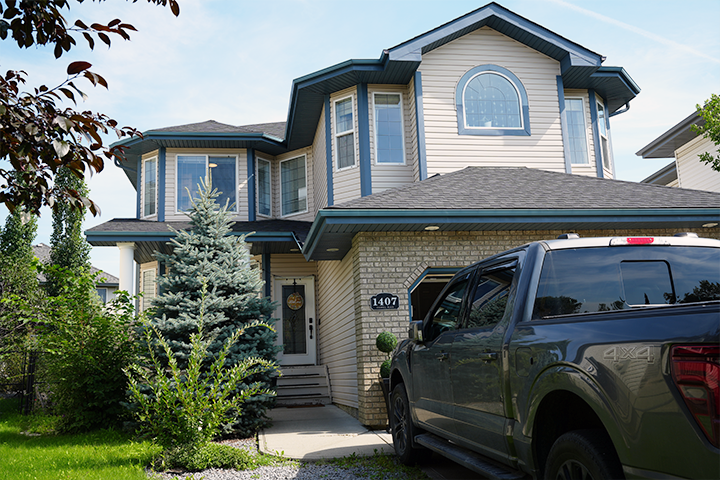
When Craig Leavitt and his family of six decided to replace the HVAC system in their 2,400-square-foot Edmonton, Alberta, home, they were looking for more than a direct replacement for their aging furnace and air conditioner.
Their existing single-stage furnace had become increasingly unreliable, requiring repairs nearly every winter. The home's aging air conditioner was also leaking refrigerant and required annual servicing, while replacement parts were becoming difficult to find. Beyond equipment reliability, the family was dealing with inconsistent temperatures, poor humidity control, and inadequate air filtration.
“The old furnace would go down every winter,” said Leavitt. “Once the temperature hit negative 30, the furnace would go down and we’d have to call someone to come repair it.”
The air conditioner had become similarly problematic. It continuously leaked refrigerant and required annual recharging, while parts for the aging equipment were no longer readily available. Inside the home, comfort was another concern. The single-stage system produced noticeable temperature swings, with some rooms becoming too warm while others remained too cold.
Rather than simply replace the existing equipment with another conventional furnace and air conditioner, the family wanted to look at different equipment options and system configurations. Through a neighbor, Leavitt was introduced to Otto Heating and Cooling, HVAC contractors that have been serving the Edmonton, Alberta, area for more than 20 years. The company handles everything from service and new home construction to retrofits and hot water heating, with a focus on indoor air quality, temperature and humidity control, and helping customers find solutions that keep their homes and businesses comfortable year-round.
“We actually looked at all the different brands,” Leavitt said. “We liked the features and technology that Navien had.”
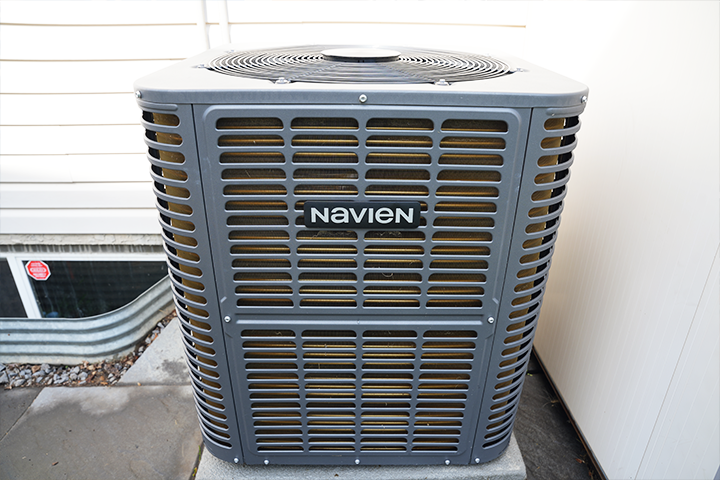
Leavitt and his family decided on a system that paired a Navien NPF Hydro-furnace with a Navien NAZ Heat Pump, providing a hybrid heating and cooling solution designed to handle the home's changing load throughout Edmonton's wide range of outdoor temperatures.
A key consideration in the Navien system was the NPF Hydro-furnace's hydronic approach to heat transfer. Rather than exposing the home's air directly to a gas-fired heat exchanger, the NPF Hydro-furnace uses heated water and a hydronic coil to transfer heat into the airstream. Leavitt specifically identified this design as one of the features that differentiated the system from his previous furnace.
“The fact that it's sort of a boiler system, so that the air is not directly in the flame and that the air doesn't come out so hot—that really helped,” he said.
The NPF Hydro-furnace also incorporates variable-capacity operation and a variable-speed ECM blower. This allows the system to adjust its output and airflow rather than operating exclusively at a single heating level. That operating approach was particularly noticeable compared with the family's previous single-stage furnace.
“We were able to adjust it so that rooms that before that were either too hot or too cold now felt as comfortable as every other room in the house,” Leavitt said. For cooling, the family selected a NAZ Heat Pump over a conventional air conditioner, giving the system the ability to provide both cooling and heating. That decision proved particularly valuable during the first winter after installation.
Edmonton's climate can present significant temperature swings, with the potential for extremely cold winter conditions as well as warm summer weather. The family wanted a system capable of maintaining comfort across those conditions while taking advantage of the efficiency opportunities provided by heat pump technology.
“Because we opted for the heat pump and not just an AC unit, the heat pump can actually heat the house most of the time and only turns on the hydro-furnace when it’s extremely cold,” Leavitt said.
During the latter portion of the family's first winter with the system, outdoor temperatures reached approximately -10°C to -15°C. Leavitt said the NAZ Heat Pump was able to maintain the home's temperature without requiring significant operation of the NPF Hydro-furnace. The hybrid configuration therefore allowed the heat pump to handle heating demand when conditions permitted while retaining the NPF Hydro-furnace as the home's gas-fired heating source when additional capacity was needed.
One of the most immediate changes for the family was the consistency of the indoor temperature. The old single-stage furnace would allow the temperature to drop before switching on and operating at full capacity. Leavitt described the experience as a cycle of becoming cold, followed by the furnace turning on, producing too much heat, and then shutting off again.
“With the old system you'd start feeling cold and then it would turn on and then you'd be too hot and it would be noisy while it was running,” he said. “Now with the Navien system the temperature almost never changes. It’s really kept quite constant.” Reducing operating noise was another benefit of moving away from the family's previous single-stage equipment. After installation, Leavitt said the difference was immediately apparent. “After we got it installed, it was so quiet we had to go the unit to make sure it was on and running,” he said.
For contractors, reducing perceived equipment noise can be an important component of overall system satisfaction, particularly in residential applications where the HVAC equipment operates throughout the day and night. In this case, the family's experience with variable operation was not simply a technical change, it was something they could hear and feel in their everyday use of the home.

The system's efficiency has also translated into measurable savings for the family. The NAZ Heat Pump's ability to adjust operation to the home's requirements has resulted in less energy consumption while maintaining a more consistent indoor temperature.
“The new system is much more efficient,” he said. “Not only are we more comfortable, but it's actually saving us a lot of money. Comparing my energy bills this year to last year, they're about half to cool the house.”
Reliability was arguably the most important driver behind the original replacement decision. The previous furnace's history of winter breakdowns had created concern about being left without heat during Edmonton's coldest weather. For Leavitt, that concern extended beyond comfort to the potential for frozen pipes and significant property damage.
“When the old furnace would quit, it was quite a concern for us that then the pipes would freeze and burst, costing us a lot of money,” he said.
The new system has provided a different ownership experience. In addition to the improved reliability Leavitt has experienced, the connected controls allow him to monitor the home's temperature remotely. “One of the advantages that we found in the new system is that we're able to log into it remotely and see if there are any issues with the system,” he said.
For a family that travels frequently, remote visibility provides an additional layer of reassurance, particularly during cold weather.
Leavitt’s installation demonstrates how combining different HVAC technologies can provide homeowners with greater flexibility than a traditional furnace-and-air-conditioner configuration.
The NAZ Heat Pump provides heating and cooling capability, allowing the system to take advantage of heat pump operation across a wide range of conditions. The NPF Hydro-furnace provides gas-fired heating capacity when additional heat is required, while its hydronic heat-transfer design and variable-capacity operation contribute to the system's overall comfort characteristics.
For Leavitt and his family, the Navien hybrid installation system design has provided an experience that he summarizes as "quieter, more comfortable, and more reliable.”


